


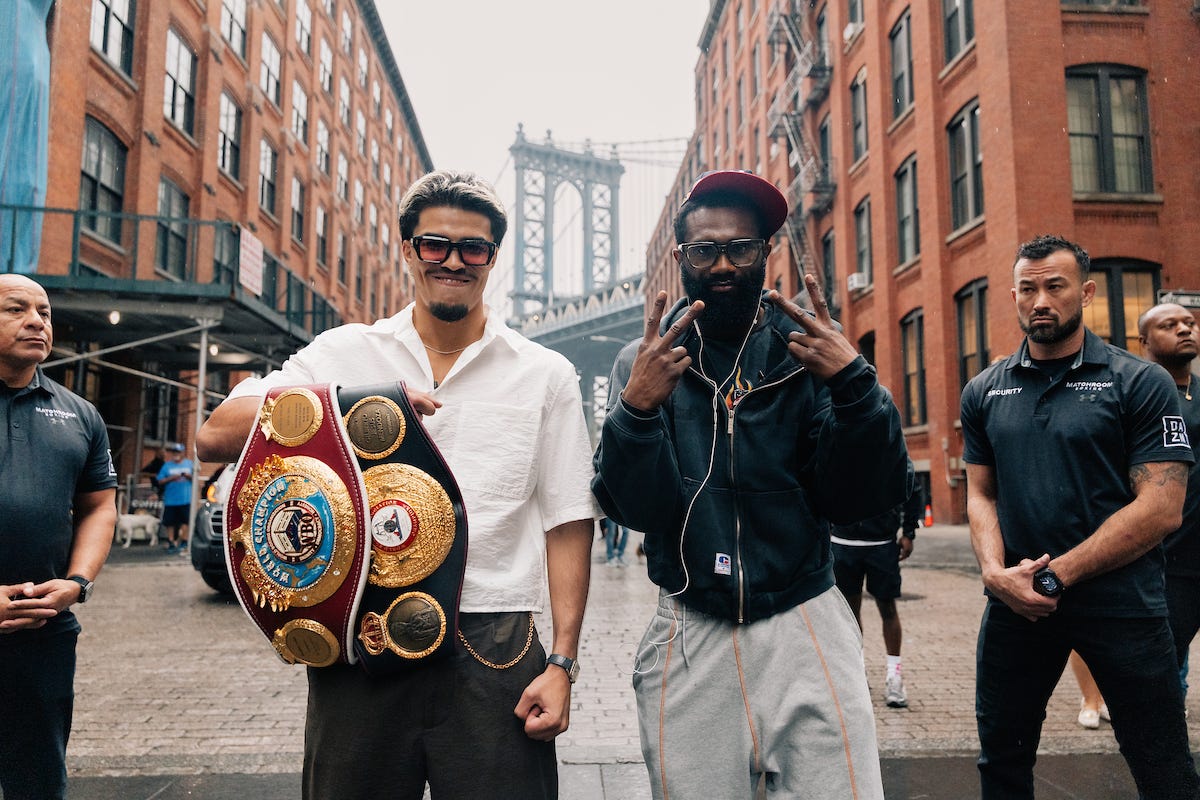
The world was a different place 25 years ago but this weekend’s bout between unified junior middleweight champion Xander Zayas and Jaron “Boots” Ennis evokes memories from then.
At the Barclays Center in Brooklyn instead of Madison Square Garden in Manhattan, a Philadelphia fighter who has not quite broken out into a crossover star meets a popular Puerto Rican who evokes the passion of a nation.
You might wonder where you’ve heard the story before, Puerto Rico vs. Philadelphia in New York.
Well, a quarter of a century ago, in the grand finale of Don King’s middleweight boxing tournament, Philadelphian Bernard Hopkins upset both the oddsmakers and King with a 12th round stoppage of Puerto Rican hero Felix Trinidad.
Despite having moved up from welterweight, and although Hopkins was a career-middleweight by that point, Trinidad was the red-hot favourite.
They produced one of the great fights and great nights of the era.
*
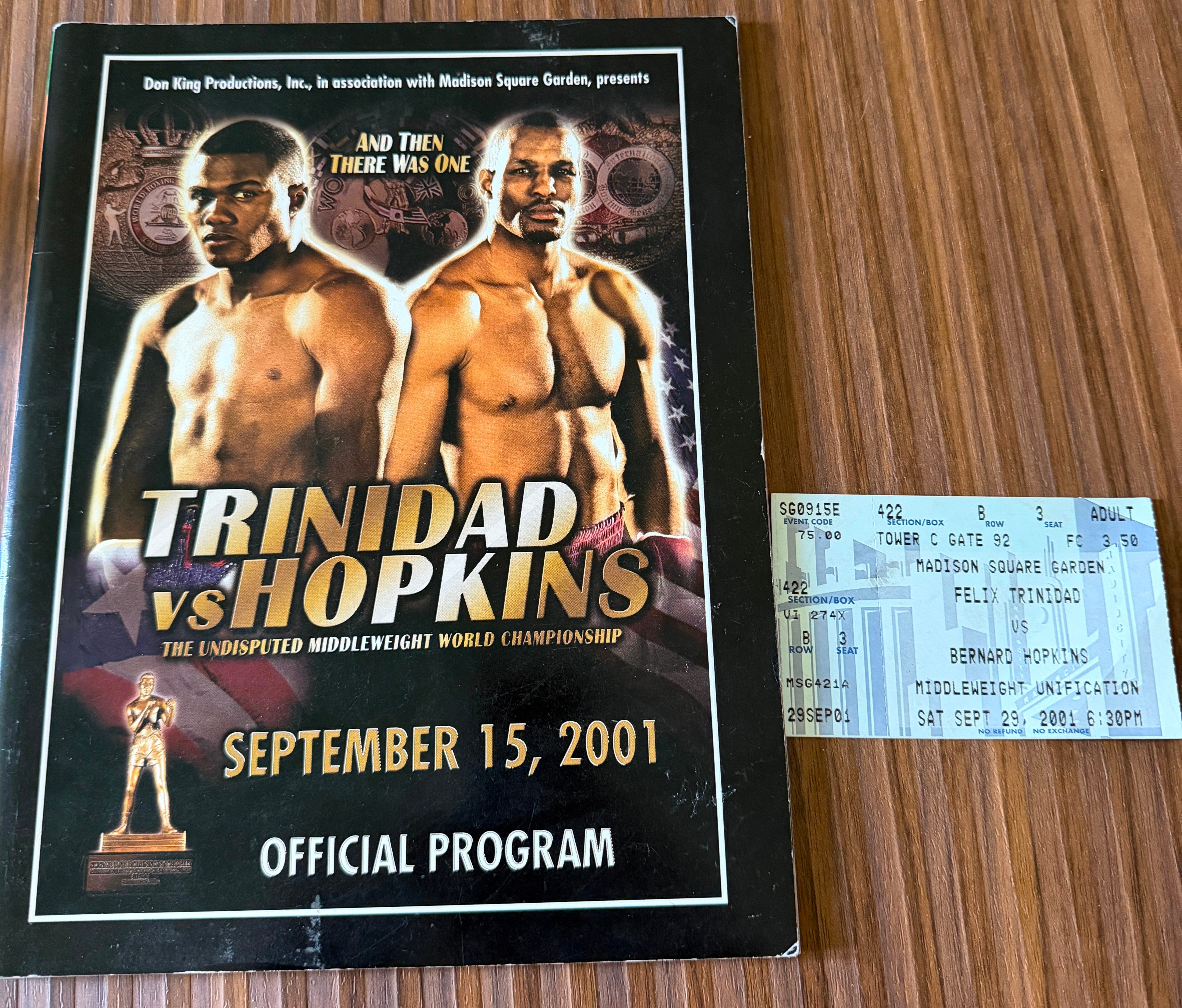
(Photo: Programme and ticket purchased on the night by the author)
Bernard Hopkins-Felix Trinidad was more than a fight and you don’t say that lightly or for the sake of coining a cliché.
The fight had been pushed back a couple of weeks in the aftermath of the 9/11 terror attacks and it was the first significant sporting event in New York after the tragedy. America was raw and I know because I was there.
I was on the outskirts of Atlantic City when the planes struck and looked out from the trailer where I was staying to see flights urgently being grounded at the nearest airport.
I’d got in from a run and turned on the news to see that the first tower had been struck and I watched in utter disbelief as live pictures showed the second hit.
For someone who wouldn’t go out of his way to be a patriot, being British and all, I felt patriotic in the weeks that followed. America came together. Now that sounds more clichéd than saying Trinidad-Hopkins was more than a fight but it was like that. I still hear Americans talk about that time and I remember the defiant flags outside the houses and seeing them being waved from the vehicles. I had been up on the Towers just a few days before, eating pizza with my ex-girlfriend who had come out to see me during one of my boxing trips around the US. We ate at the Top of the World restaurant, of which the remnants would have been on the ground-floor a week later. America was raw and it grieved.
Even when they said Trinidad-Hopkins was back on, it felt too soon.
But it also felt like it was now written that Hopkins would win. That wasn’t a boxing hunch, that was a life hunch. Fate replaced odds. Self-belief replaced knockout power. Destiny trumped youth. For it was Hopkins’ faith in himself that allowed him to use the fate of some 3,000 victims into fulfilling his destiny. Because B-Hop was galvanised.
He was naturally rebellious, anyway. Of course, he’d made headlines in the press tour when he grabbed the Puerto Rico flag from Trinidad in San Juan and threw it on the floor. Not only did he have to then be pulled away from his free-swinging opponent, but he had to be evacuated amid riotous crowd scenes. There were many who thought that both the battle and the war between the two fighters was won and lost then. Trinidad lost his cool and never regained it.
Hopkins’ then adviser, Lou DiBella, said at the time: “Tito being ticked off plays into Bernard’s hands. Bernard wants Trinidad to run across the ring and start winging bombs. He wants to get right on Trinidad’s chest and stay there. He doesn’t want Trinidad to fight from range, at which he’s most comfortable. So what’s the best way to do that? By getting into the guy’s head and making him crazy.”
Hopkins reckoned he saw fear in Trinidad’s eyes, even though it was he who was supposed to have trepidation around the heavy hands of the Puerto Rican KO king.
But Hopkins summed it up when he said: “I don’t have to treat Trinidad nice. I don’t have to treat his country nice. I don’t like his family. I’m not supposed to like him, and I don’t want him to like me. Does that make me a devil? I’m a fighter. I’m ready to go to war. This is no fun and games.”
**
I went to Madison Square Garden to watch the fight with light-heavyweight great Matthew Saad Muhammad. We went up in Saad’s battered old Cadillac and I was amazed that both he got us to where we needed to go and that the car made it. I still have no idea how we managed that, in a pre-cell phone era, without GPS, Google Maps et al. I know Matthew used to travel from Philly to New York a lot, at one spell for acting classes, and another time to pick up an expensive Steinway piano he bought in his heyday, but I had no faith we’d get there.
I also had no faith that Matthew in 2001 would have the necessary clout to get us in. He had been the WBC champion two decades earlier, and he’d even fought in The Garden but, alas, he couldn’t get us in and I fronted up the $75 per ticket for us to get in.
We were in the nosebleeds and scaled the zig-zagging escalators to eventually take our seats.
From there, well, on the screens above, I was able to watch the masterful Ricardo Lopez in action on the undercard, in the final fight of his career.
But what I remembered most, until the main event, was the post-9/11 sentiment and how united the audience was in affording a rapturous ovation for the first responders Don King had gifted tickets to, and when R and B singer Ginuwine sang the US national anthem. People around me in the cheap seats were crying and the hairs on the back of my neck stood up. Even I, a 22-year-old English kid who lived more than 3,000 miles away, was American at that moment.
***
Felix Trinidad was supposed to be the next great middleweight and King’s tournament was designed to anoint him as such.
As The Garden’s CEO, Seth Abraham, said proudly in the big-fight programme: “The winner of tonight’s World Middleweight Unification prizefight between Felix Trinidad and Bernard Hopkins will be the one and only 160-pound champion. Undisputed, unchallenged, inarguably the world’s best middleweight king.”
It had been 14 years since Marvin Hagler had managed to stitch together recognition as the indisputable leader of the division.
The prize for winning the tournament and unifying the belts was not just the titles but also the Sugar Ray Robinson Trophy. Of course, it didn’t take off. It likely sits in Hopkins’ basement, although Bert Sugar seemed convinced it was boxing’s new showpiece bauble.
“College football has its Heisman Trophy, pro football its Lombardi Trophy, college basketball its Larry O’Brien Trophy, baseball its Cy Young Award… and now boxing has its own piece of hardware, one which can rightfully take its place in sports’ trophy case alongside the others: The Sugar Ray Robinson Trophy,” he fawned.
Anyway, Hopkins was making the 14th defence of his IBF middleweight title and the first of the WBC belt he won against Keith Holmes in the opening round of the tournament, while Trinidad was putting up the WBA belt he’d iced William Joppy for. Trinidad was a 2/1-on favourite.
The chip that would remain on Hopkins’ shoulder for his career was in evidence when he spoke to Hall of Fame writer Bernard Fernandez ahead of the bout.
Bernard talked about the five years he served in prison for robbery and about life in what is known as “The Badlands” of Philadelphia.
“I came from ‘The Badlands’ where people have problems,” he said. “They’re smoking crack, they’re drinking, they’re shooting dope, they’re prostituting, they’re stealing, they’re scheming, they’re conning. When I go back, some corners I stop at, some I don’t. Some barbershops I go into, some I don’t. But I know where the love is, and I give that love right back.”
He told Fernandez that he had no intention of thanking Trinidad for the opportunity or being grateful for having the chance to further his career against a boxing A-lister.
“He’s not giving me anything I’m not giving him,” Hopkins said stoically.
****
Aside from the Philly vs. Puerto Rico in New York angle, there’s not a whole lot of similarities, if the truth be told.
Twenty-five years ago, it was the Puerto Rican having to prove himself in a new weight class, now it is the Philadelphian’s turn.
Hopkins was methodical, economical, and utilised mind games. Ennis is fast, furious and you have to hold on to your hat when he fights.
Trinidad was vulnerable. He touched down multiple times but he had that emphatic equaliser and when he destroyed Joppy at middleweight, that only reinforced the notion that he would – at some point – catch up with Hopkins and likely stop the veteran. Zayas doesn’t have that same KO reputation. Ennis is more machine gun than Hopkins, the considered sniper, Zayas is more of a baseball bat guy than the stick of dynamite Trinidad was.
This weekend, however, Zayas will walk to the ring as the WBO and WBA 154lbs champion and he will defend an unbeaten record that now sees his stats at 23-0 (13 KOs). That is 17 wins shy of where Tito was. Zayas is only 23, and driven by a clear ambition. An impressive win over Boots, and he will be looking to join that rarefied air that hosts the likes of Trinidad and Miguel Cotto in the modern-day great stakes from his proud island. For Ennis, who unified two of the belts at 147lbs, he brings a 35-0 (31 KOs) ledger and despite several credible wins, he’s not broken through the way Hopkins did after he defeated Trinidad. This could do that.
Hopkins, by the way, was a more complicated 39-2-1 (28 KOs) while Trinidad was a sparkling 40-0.
Hopkins was the hard-luck kid. He’d lost his debut, had lost a decision to Roy Jones, was dropped twice and drew with Segundo Mercado (who he defeated in a rematch), with the first fight being for the vacant IBF 160lbs title and Hopkins claiming it in a return four months later.
And despite wins over Joe Lipsey, Antwun Echols (twice), John David Jackson, Simon Brown, and then adding Holmes’ WBC title, the respect he merited eluded him.
That was where Trinidad came into it.
*****
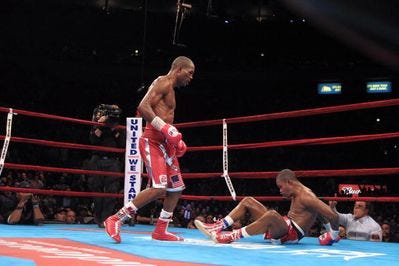
Everything changed after Hopkins-Trinidad. New York and America continued to heal and major events were restarted.
Trinidad’s air of menace and invincibility left for good and Hopkins galloped up the pound-for-pound lists. Finally, he was a star.
Trinidad was only 28 but he’d burned brightly. Hopkins was 36 and about to enter another act in his career that saw him box at world class for another 15 years, setting records in the sport and at light heavyweight with his phenomenal, age-defying feats.
And there was no doubt who was the world champion at 160lbs. That is different to Saturday, at 154lbs, where Josh Kelly has a belt and the likes of Vergil Ortiz and Sebastian Fundora will contest the claim of anyone who says they are No. 1 in the division.
And as for Trinidad-Hopkins, yes, there were subplots. There had been the flag throw, 9/11 and the emotion of the occasion, but nothing detracted from the amazement of watching Trinidad getting muzzled in The Garden. And you could tell from early on how the fight would trend to the point that it seemed a minor miracle that Trinidad had even made it to the opening bell of the 12th round. It hadn’t been a shutout on the scorecards up to then, but it had been psychologically.
The lasting image I had, from the cheapest seats in the house, was Hopkins attempting an ungainly forward roll in celebration. The old man – as he was seen then – was hit with the childlike enthusiasm to stoop to the canvas and act like he was five years old. That was “The Executioner.” Well, he had at least executed Trinidad in the ring with far more aplomb than he did the gymnastics.
(Main picture at the top: Zachariah Delgado/Matchroom Boxing)
Loving this comparison. I remember the Hop-Tito fight well. The Puerto Rican flag controversy, backdrop of 9-11 and initial postponement. All leading to Hopkins putting on a clinic, having entered Trinidad’s head and turning him from destroyer of Joppy to one-dimensional deliverer of left hooks.
Then there was Larry Merchant on commentary, checking George Foreman who kept on expecting Trinidad’s power to land: “Why won’t you give Hopkins any credit, George?”