


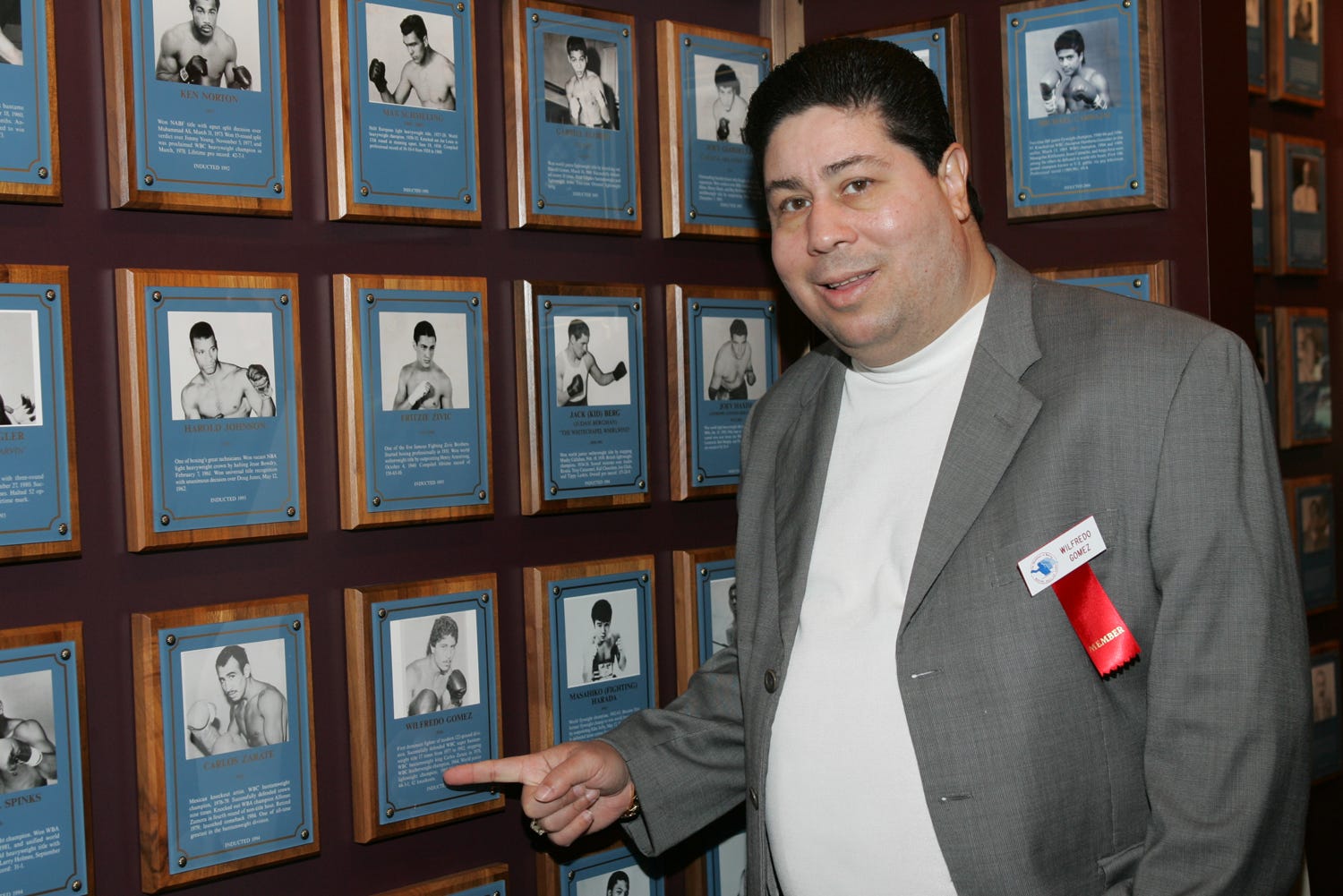
When the flags flicker in the wind at half-mast outside the International Boxing Hall of Fame, you know that one of the men or women we once considered immortal has passed.
Those who have earned a plaque on the hallowed walls inside the museum grounds may live forever in our minds, hoisted aloft in victory, adorned in championship belts, remembered forever at the peak of their powers, but by the time the great Wilfredo Gomez passed away last week (October 10), aged 69, his best days were long behind him.
But Gomez, the Bazooka, will never be forgotten.
Wilfredo Gomez was so good that even his phenomenal career statistics don’t do him justice. He was one of Puerto Rico’s greats, a three-weight world champion who, after an early draw, ran up 32 straight knockouts, was one of the heaviest hitters in history, having made 17 defences of his first world title. Then you get to the opponents, and he defeated the likes of Juan Laporte, Lupe Pintor, Rocky Lockridge, and Carlos Zarate, while losing to fellow Hall of Famers Azumah Nelson and Salvador Sanchez.
He fought as a pro between 1974 and 1989 and boasted a final record of 44 wins against three losses and a draw with an astonishing 42 stoppage wins.
*
Gomez, who grew up in Las Monjas, Puerto Rico, sold candy on the streets to make money as a kid but it wasn’t long until he was fighting his way to a better life.
He boxed as a flyweight at the 1972 Olympics several weeks before his 16th birthday and struck gold at the inaugural World Amateur Championships in Cuba in 1974 at bantamweight. He wanted to make money, so he didn’t hang around for the Montreal Olympics of 1976, turning pro aged 17.
Gomez started his pro career off with a draw against Jacinto Fuentes in Panama. Fuentes was 2-1 at the time and he had a hard start to his career. His previous fight was against the great Eusebio Pedroza, who was then 4-0. Little wonder that Fuentes retired with a 10-11-1 record with matchmaking like that.
And Gomez wasn’t done with him, either, taking two rounds to stop him in a return six months on from their first fight. In fact, after that early draw, no one heard the final bell against Gomez for the next seven years.
On Wilfredo’s way through – a blistering stoppage streak of 33 bouts – he halted former WBA champion Alberto Davila and that saw him earn a shot at the WBC super-bantam title against Korea’s Dong Kyun Yum, who – despite dropping Gomez early in the first round – was stopped in the 12th of a hard fight.
As well as boxing in Puerto Rico, Wilfredo made defences in Japan and Thailand, and in 1978 blew through the brilliant Carlos Zarate, then the reigning Fighter of the Year, in just five rounds. It was said that Zarate had never before lost a fight, amateur or pro. He was 52-0 at the time.
While Zarate was far from done, it represented a torch-passing of sorts after the great Mexican was stopped in front of 11,000 fans at the Roberto Clemente Stadium with some 28,000 fans watching on video in an open-air arena next door.
Zarate wanted a rematch and his manager, Cuyo Hernandez, said his fighter was in “the worst condition” he had been in for a bout.
Gomez didn’t care.
“I always knew that I could beat him, and I proved it tonight,” said the winner. “I really feel good about this victory because I didn’t fail my people and I beat a great fighter.”
He also made $175,000 to Zarate’s 75 grand. Gomez, incidentally, remembered Zarate as the biggest puncher he faced when asked about it later in life.
And Gomez moved onwards but faced regular battles with the scales. He had to drop 6lb ahead of defeating Nestor Martinez in his next bout but the knockouts and stoppages kept coming.
He dropped Derrik Holmes eight times in front of a star-studded Las Vegas crowd that included the Rocky duo of Sylvester Stallone and Carl Weathers in 1980 but two fights later Gomez tasted defeat for the first time when he moved up in weight and ran into the great Mexican featherweight Salvador Sanchez.
Young Sanchez, a 2-1 underdog, was brilliant, flooring Gomez twice and stopping him in eight rounds.
A crowd of 4,500 packed Caesars Palace in Vegas (said to have included 3,000 Mexicans) to watch them go to war in “The Battle of Little Giants” and Hall of Famer Graham Houston, ringside, wrote Gomez had been “clinically jabbed, countered and eventually pounded to defeat by an ice-cold fighting machine.”
Gomez had been dropped and hurt in the very first round but steadied the ship as the fight wore on. He was down again in the eighth, however, and although he made it back to his feet, referee Carlos Padilla took a look into his eyes and waved it off. The Puerto Rican’s face was a mess.
“Blood was splattering from Gomez’ nose and the noise of the crowd beat down like thunder on the ring,” wrote Houston, who had previewed the fight with the highest compliment saying it took the featherweight division back to the days of Pep and Saddler.
Astonishingly, the fight wasn’t picked up by a significant US broadcaster.
Sanchez made a reported $750,000 while Gomez was getting $450,000, setting a record of more than a million bucks for a featherweight fight.
For a while, Gomez became reclusive. He wasn’t sure whether his fans would still accept him, but his body of work meant that no one was too hung up on him losing to the brilliant curly-haired Mexican.
He was soon back to winning ways, too, and still was the WBC champion at super-bantamweight, notching quality wins over the likes of Juan Meza and Juan Antonio Lopez before another big fight, against the superb Lupe Pintor.
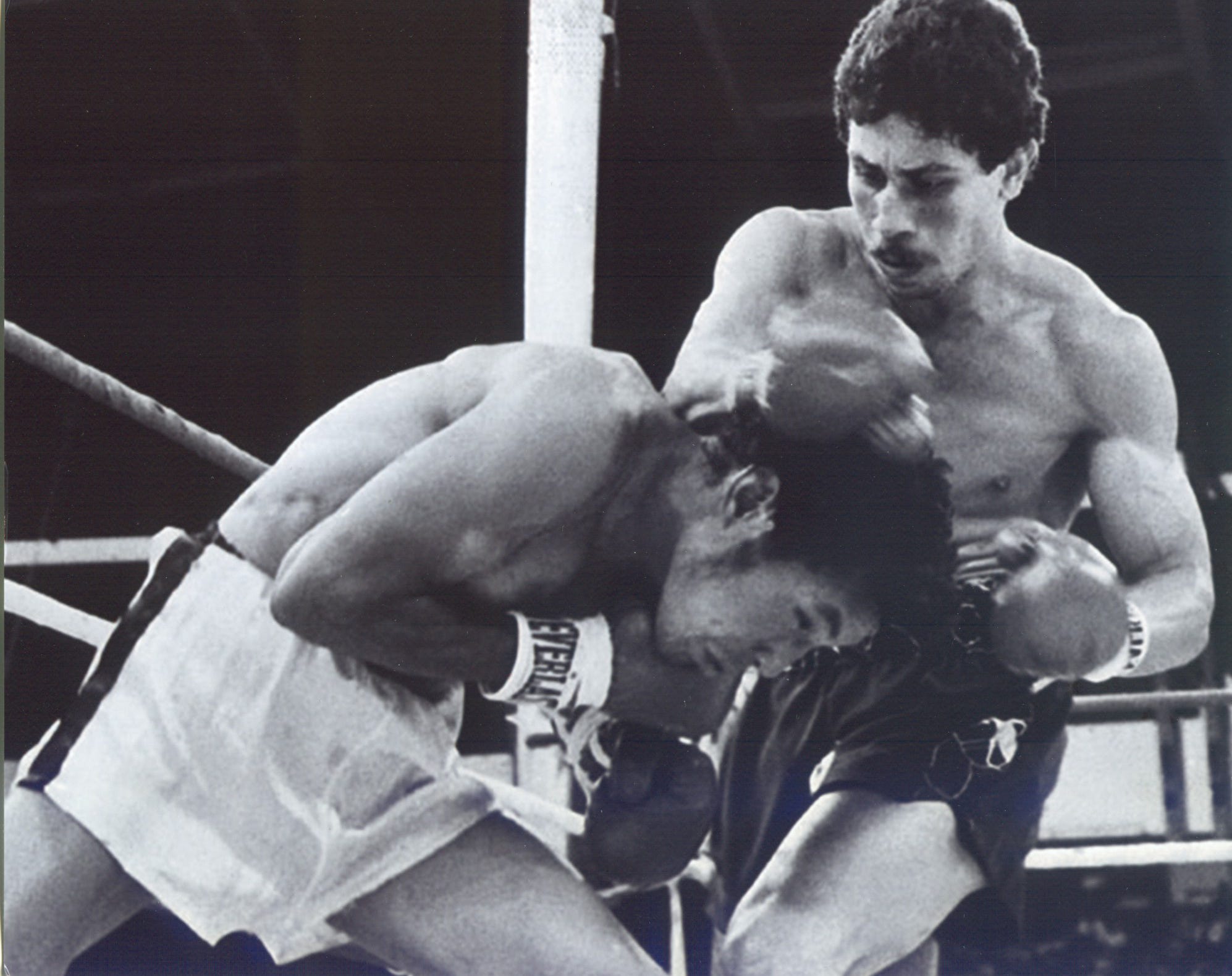
The Gomez-Pintor classic, co-featured alongside Thomas Hearns-Wilfred Benitez in the Superdome, New Orleans, was marvellous. One ringsider would later call it “one of the greatest [fights] in years for sustained action of the highest quality.”
There were many who felt Gomez, “affluent” after a record-setting number of defences of his title, had lost his ambition, but he needed every ounce of it against Pintor, who he referred to as his toughest opponent having stopped him in round 14.
Gomez had always been perpetual motion.
His variety with his left hand alone gave opponents enough to think about, often changing the angle of his jab, thundering left hooks to the body and bringing it up top and then doing the same in reverse.
Gil Clancy once said of Gomez: “You miss me, I hit you.”
“I just keep hitting them until they can’t stand it anymore. Then they fall down,” Gomez said himself.
Not many were more colourful in their descriptions than veteran hack Bert Sugar, who wrote: “Walking right into the teeth of a storm to set up shop, Gomez would camp out in front of his opponent and start throwing an entire arsenal of destructive punches from every angle.”
Veteran New York diarist Eddie Cool once wrote, unequivocally, “Gomez is undoubtedly the best and most popular pugilist ever produced by Puerto Rico.”
There were two more wins in 1983 as Gomez vacated his title and moved up to featherweight and this time he was crowned champion.
He had made a phenomenal 17 successful defences of his WBC title at super-bantamweight, even though the new title in the new weight class wasn’t getting traction everywhere.
It was, for many, unglamorous and had only been introduced the year he won the title. Sports executive Sonny Werblin once questioned: “What the hell is a super-bantamweight?”
Well, not many could legitimise it the way Gomez did.
The great Sanchez had lost his life in a tragic car accident and Juan Laporte had won the vacant title.
It was thought Laporte – the champion – made $525,000 while Gomez earned $175,000, though his purse was supposedly bolstered by the gate receipts from the Roberto Clemente Coliseum.
Laporte and Gomez guaranteed “ferocity,” read the excited Boxing News preview.
Experts pointed to Laporte faring better against Sanchez as an indicator that he would be too much for Gomez, but he was coming off a shock non-title loss to Gerald Hayes and Steve Connolly wrote that Gomez could, at the time, be considered the most complete fighter in the world.
Laporte, however, was hospitalised after the clash having reportedly broken several fingers. Gomez also broke his right hand, and said he felt it go in the fourth, although it had not stopped him pounding out a 12-round decision win.
But next up was another all-time great and Azumah Nelson stopped Gomez in 11 rounds.
Nelson boxed Gomez as part of a twin-bill that saw Gerry Cooney fight George Chaplin in Arizona. It was the heavyweights who got most of the headlines, but the real class saw the 19-1 and 26-year-old Nelson, only defeated, too, by the brilliant Sanchez, and Gomez, 41-1-1 – both future Hall of Famers – battle in San Juan.
The great Ghanaian was the No. 1 contender and Gomez didn’t dodge the smoke. It was a different time.
But that night, in front of 12,000 fans outdoors at the Hiram Bithorn stadium, Nelson was too good.
“Gomez stunner – Nelson flattens world champion” headlined Boxing News.
There was just one second left in the 11th round and the Puerto Rican had been ahead on two scorecards after 10 rounds but even the best shots from “Bazooka” failed to compromise the African “Professor.”
Gomez was dropped twice in that decisive session, the second time causing the fight to be stopped. As much as he tried to stand, Wilfredo sank back down and the fight was over.
It had been another thriller. Nelson had shown him no respect and Gomez kept coming. By the eighth, Gomez’s features were lumpy and there was blood in his mouth. One writer said that, even by then, “he was fighting on heart and instinct alone.”
Some felt he was fatigued because he’d not trained hard enough, that he’d taken Nelson lightly. But that was surely unlikely.
Nelson was perhaps more accurate when he said afterwards: “His best years are behind him.”
But Gomez was always classy, and described once by Boxing News as “one of the outstanding modern fighters” who was “technically versatile.”
Another writer said of Gomez that, “although he’s a clever craftsman, he often sacrifices his skills because he loves to fight.”
“Tirelessly methodical,” wrote another, “with a virtually endless punch repertoire.”
It was felt the Nelson-Gomez winner would be headed into a fight with Irish hero Barry McGuigan but neither got to fight the ‘Clones Cyclone.’
By 1985, speculation that Gomez might be resting on his laurels failed to amount to anything when he went to war with Rocky Lockridge in San Juan to claim his third world title.
Those who felt the loss to Nelson the previous year had meant the end of the road were proved wrong.
“A bruised and battered Wilfredo Gomez called on heart and ring generalship to rally in the late rounds to win a majority 15-round decision over Rocky Lockridge and capture the WBA junior-lightweight title,” said Boxing News.
Lockridge had his moments but slowed after the 11th round and Gomez, roared on by 10,000 fans in the Roberto Clemente Stadium, turned the screws and won a close majority decision, adding the WBA super-featherweight belt to his WBC titles at super-bantamweight and featherweight.
Lockridge admitted he had been spent during the final third of the bout, and even trainer Lou Duva’s cries for him to “Punch, punch, punch” were largely unanswered.
A year on, however, Gomez was shocked by Panamanian dangerman Alfredo Layne and his career became more stop-start, with more stop than start.
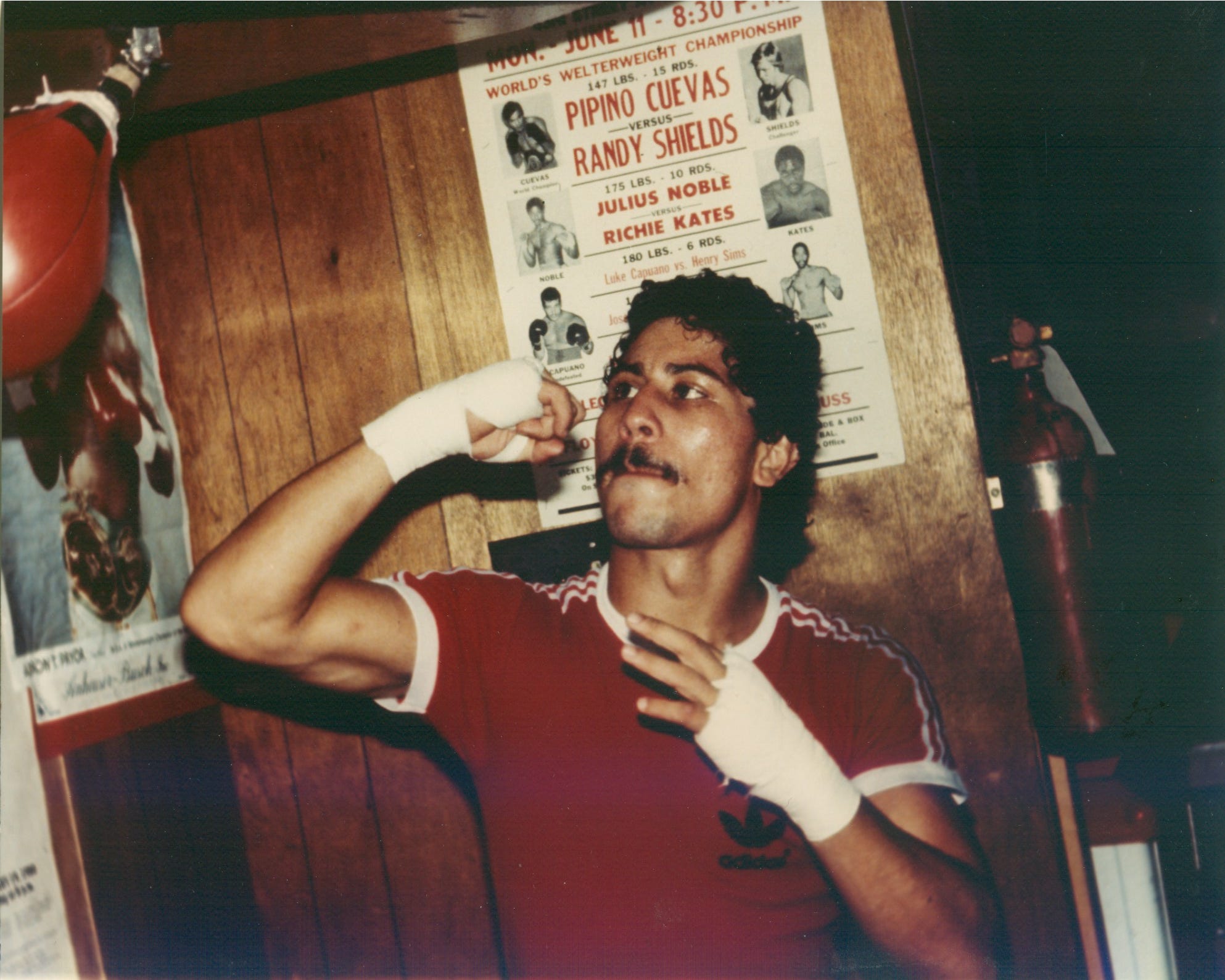
Some felt the 1988 Gomez was still a menace. “Gomez still full of firepower,” read one headline, after a comeback win in Florida that saw him stop Mario Gonzalez in round six of a scheduled 10 having been out of the ring for more than two years.
In part, the bout was noteworthy because Gomez kept losing his footing in some new boxing boots and had to change his footwear after round four to get better purchase on the ring canvas. He said it had felt like he was fighting on ice.
Gomez didn’t box for another year but returned to stop late replacement Mario Salazar in round two in Hollywood, Florida but, aged just 32, that was it for the three-time champ.
Unflattering reports said Gomez “looked heavy around the middle” despite having dropped some 30lbs ahead of the fight that saw him come in around the junior welter limit.
Gomez promised he would be in better condition next time, and he pledged to win a fourth title, but it was all over.
He moved to Venezuela and fell in with the wrong crowd and wound up in drug rehab in Colombia but he managed to clean up, becoming a born-again Christian.
In 2006, Wilfredo – sounding content – spoke to Fightnews and said he was living in Puerto Rico, about an hour from the Wilfredo Gomez arena in Guaynabo, where he was helping train youngsters having been in recovery for eight years – free of alcohol and cocaine.
Asked what he would say to youths to help keep them on the straight and narrow, Gomez said: “I would tell them to learn from the mistakes I made in life. I would advise them to maintain a clean and healthy lifestyle. Please for the sake of your well-being and future, live a healthy and disciplined life.”
Rightly, the former champion was proud of all that he’d accomplished. But not even the stats did him justice.
“If you know your history you will see I had 32 consecutive knockouts,” Gomez told Jason Gonzalez. “And 17 out of those 32 consecutive knockouts were title defences. A record that has yet to be broken. I don’t want people to think that I am full of myself, but I feel I earned the right to be called the greatest Puerto Rican champion of all time. There was nothing that I could not do. I could box, I could punch, I had defence, and most importantly I had guts.”
**
The great raconteur Bert Sugar once paid tribute to Gomez and his ring moniker when he wrote: “The bazooka, a small, portable military weapon capable of firing armour-piercing explosives at close range, came out of World War II. Wilfredo Gomez, a small compact fighter capable of firing his own explosives close-in, came out of the gyms of Puerto Rico three decades later. It’s questionable which possessed the greater firepower – the long, metal single smoothbore tube or the double-barrelled fighter known as ‘Bazooka’ Gomez.”
That just about says it all.
“Losing is worse than dying,” Gomez once said as he looked to come back after the defeat to Sanchez.
When he made one of his first public appearances after that loss, the 5ft 5ins dynamo thanked those in attendance at a dinner for not forgetting him.
That was in 1982. It is fair to say his legend will live on far beyond anything the humble Gomez would have ever believed.
Wilfredo Gomez was not just a Puerto Rican great and a boxing legend. He was a national treasure.
The flags might be fluttering at half-mast in Canastota, but not to worry. It’s just the ‘Bazooka’ letting off a couple of rounds upstairs now he’s been reunited with Sanchez, Lockridge and the other greats.
As a kid I remember reading the great Graham Houston’s BN preview and thinking, no he’s got this wrong surely, this Puerto Rican superstar with the unbelievable record is unbeatable and Sanchez is going to lose. But if I’d actually been able to see some of their fights, maybe it would’ve been clear to me that Sanchez had a chin of iron, and along with the size, that was one big advantage he had over Wilfredo. Watching many of his fights in the run-up to the Sanchez fight recently, it’s clear that Gomez could be hurt, and boy oh boy, that first round- that pretty much finished him right there and then; Sanchez dropped him then unmercifully capitalised. God knows how Wilfredo managed to survive that round, what a heart he had; from then on it was that massive heart dragging him through to the fateful conclusion. There’s a terrific documentary about him out there called bazooka - not sure if it’s still on YouTube. RIP El Gran Campeon.