


Sometimes this sport is a dog’s world. A place that is lonely, aggressive, where doors slam shut, snide things are said, backroom deals are done and ethics are parked at the door.
At other times, it is the most welcoming, uniting sport you could hope to be a part of.
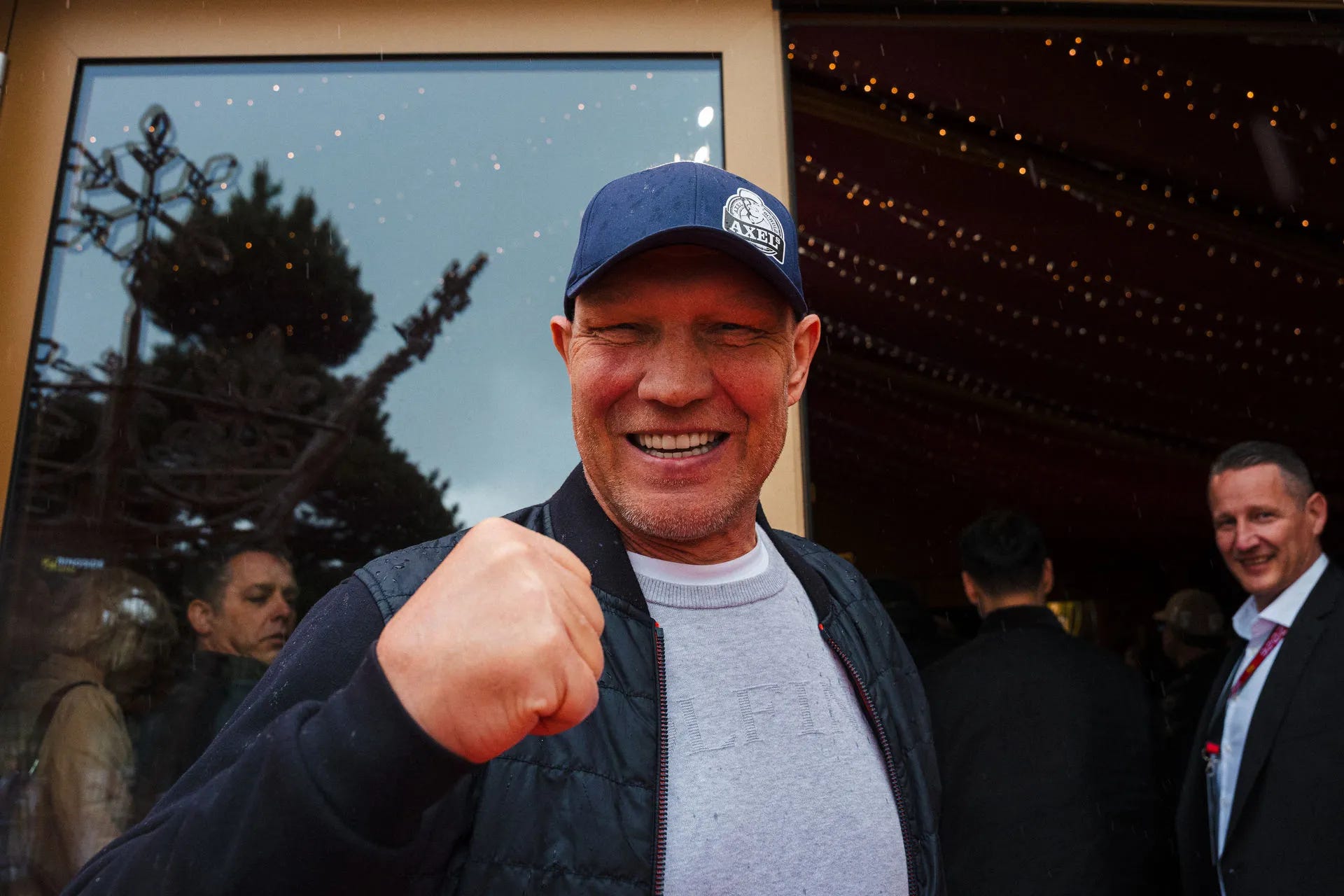
I’m sitting with Axel Schulz, the German heavyweight icon – and even that grand title doesn’t really do him justice – and via a translator, we are talking about his career.
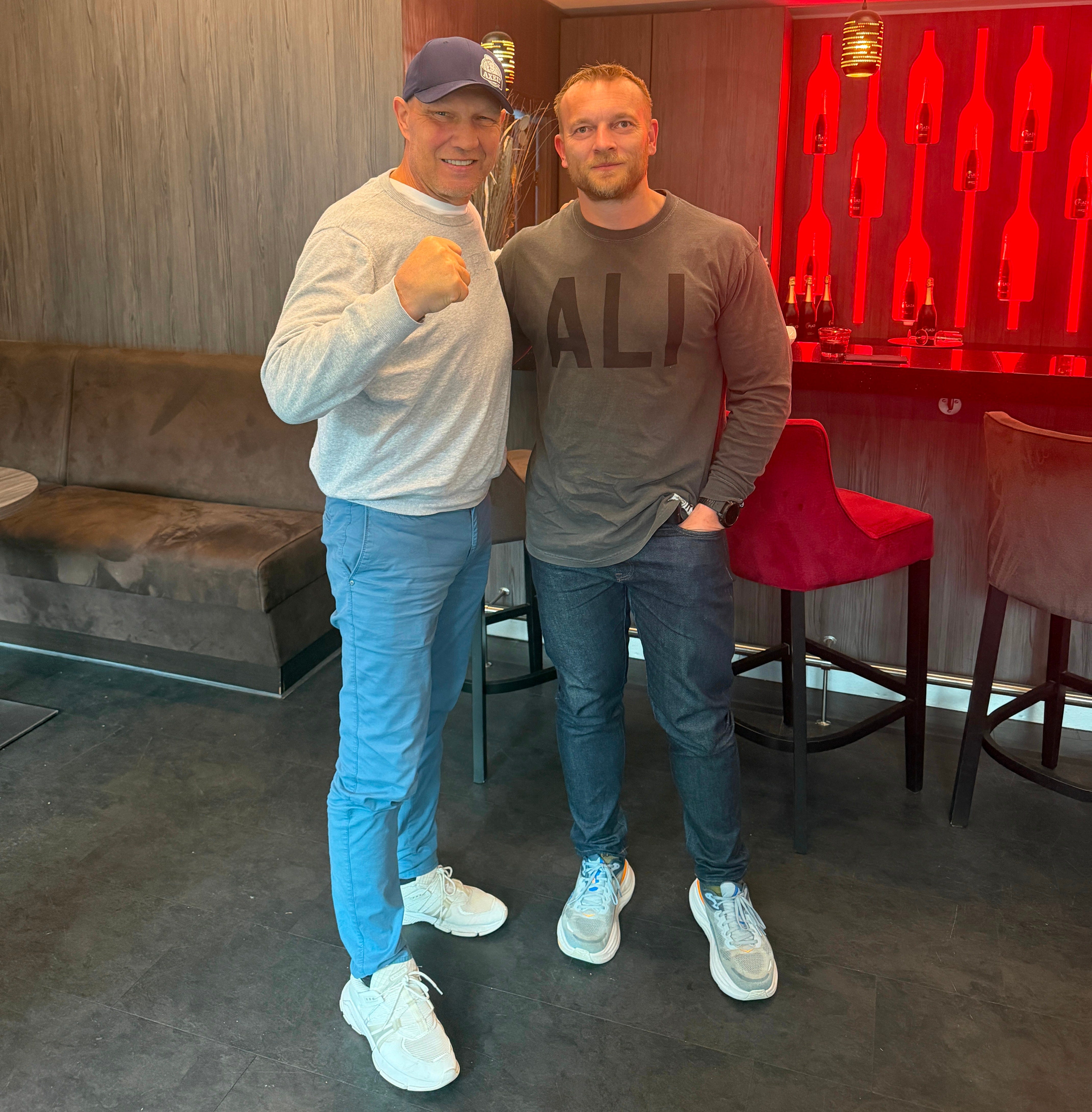
Sat in a quiet corner of a hotel lobby near Mannheim, he’s perched with a glass of water in one hand, wearing some pale blue slacks, bright white Lacoste trainers, a long-sleeved grey sweater with a white T-shirt beneath and a hat with a boxing glove and ‘Axel’ written on it.
There are no real signs of his former profession.
He no longer looks like a heavyweight, though he remains well-built. His teeth are immaculate, to the extent that they are noticeably pristine, his nose is not flattened and he smiles warmly, the way a grandfather might do when his relatives arrive.
Schulz kindly plays the hits for me.
He talks about his nights against George Foreman, Michael Moorer and Francois Botha, but we will get to them.
I see him listening to me intently, trying to pick out words that he knows. His English is actually not that bad, and supersedes by far the remnants of my GCSE German, which scraped me a C grade in 1995.
We must have been talking for about five minutes, however, before I said some words that caused him to smile. I said Henry Maske, Fritz Sdunek, Uli Wegner, Ruediger May and his eyes lit up.
Suddenly, this man who was already just fine giving me some time invited me in to a deeper conversation.
“You know your stuff,” he said, and he leaned towards me with a welcoming enthusiasm.
“Torsten May,” he added, as I compiled the list and asked about the evaporation of the German boxing market.
But then I get back to what I’m here to find out about, Axel and his life in and after boxing.
“It’s been very interesting,” he beams. “I’ve been a very busy man. I go to live [boxing] shows, and I have other projects. For 13 years, I’ve been in the food and beverage business, and my main focus is on barbecue sauce and barbecue rub.”
With that, he reaches for his iPhone and shows me a new gin brand that is also now part of his range.
But it was the BBQ sauce that allowed him to crack the market.
One wonders if that was his answer to his old foe, Foreman, and his grilling machine.
“It was a coincidence,” he smiles. “And now I have 31 licensed products in supermarkets and online.”
I joked that they should have worked together. Schulz laughed at that.
And his story is threaded through that of the second-coming of Big George.
They met in 1995 in the MGM Grand in Las Vegas. Foreman was defending the title he’d beaten Michael Moorer for and the old American was a big favourite. Foreman also made $10m to the German’s $350,000.
At the end of the fight, Schulz held his arms aloft, convinced he’d done enough and HBO’s Harold Lederman felt he’d won by 117-111 but, alas, the judges favoured Foreman and a forlorn Schulz left empty-handed on the wrong end of a dubious majority decision.
When I asked Schulz whether he harboured any ill-feeling toward what happened in Sin City, he only smiled. And when I tried to prompt some emotion, he only grew more defiant.
“Yes, but it’s a long time ago. It’s 30 years ago,” he said, plainly.
Then, he concedes he directs stronger feelings elsewhere.
“It was the fight with Francois Botha that I wanted again, after that fight it was a bit crazy for me,” he explained. “I had a fight with Michael Moorer, it was very close but that is also okay.”
This time he was undone by a split decision, and in Germany.
Did that particularly bother him?
“No, not at all,” he smiled, trying not to give ground.
Then, however, he offered again: “But I was upset about Botha. I would have liked to have that again. I was more upset by that one than I was not fighting Foreman again.”
Because in between fighting Foreman and Moorer, Schulz ‘lost’ a decision to the South African in a fight that was later changed to a No Contest when Botha tested positive for steroids.
Again, many felt Schulz had won, and from the 11,000 fans in the Hans-Martin-Schleyer-Halle in Stuttgart, coins and beer bottles were flung into the ring in disapproval. But what really got to Schulz came later, when Botha failed his test.
It was heralded by many as a ground-breaking case.
“The doping scandal then actually turned out to be quite a catalyst for change in the industry and, because of that, there was more attention on doping, to prevent more of it,” he said. “The motivation behind today’s doping plan is thanks to that particular event. I felt there was an injustice and my motivation was to get a rematch – because of the injustice.”
I asked Schulz whether he felt doping in boxing was commonplace back then, mentioning the old Ivan Drago stereotype.
“I didn’t think about it. The whole Eastern European situation wasn’t part of my dialogue,” he said. “I think it was big in boxing then, before the testing.”
Schulz turned pro in 1990 and boxed up until an ill-fated one-fight comeback against Brian Minto in 2006.
“Money,” he said of his motivation to return. “I had no TV station, nothing, until Evander Holyfield fought [Nikolai] Valuev and I was an expert for Bild, the newspaper, and that came through Don King.”
He has been a staple ringside since, and I observed him regularly being stopped for pictures. The way I saw people talk about him once they realised who he was was different.
He wasn’t just a celebrity, he was someone who was clearly a part of the German household fabric. Everyone knew who Axel Schulz was.
In part, that is down to his post-boxing empire as well as his fighting days.
He and light heavyweight star Henry Maske were huge draws in Germany in the 1990s.
“Back then, it was a focus on one fight and one fight only,” he said of the structure of German shows and lack of depth in the bills. “It made it difficult to build up the next generation. It was sad, yes, but the most important thing is me and Henry Maske really worked hard for it. After the [Berlin] Wall came down, we were the two who went out of our way and got fighting. RTL [the TV station] came later on and boxing blew up. We did it with hard work but the focus was on the main fight and there being no focus on the undercard after we were no longer boxing – it was too late – because there was no platform for the next generation.”
There have been moments of German success since. The likes of Sven Ottke, Markus Beyer and Felix Sturm came later, but Germany was never known for its deep bills.
“If I compare it to MMA here in Europe, where the fighters are presented and introduced to everyone when the stadium is already full, that is something we could incorporate in boxing,” Schulz said.
And life after boxing has been good to Axel.
He is clearly content with his career, having twice boxed Henry Akinwande, fought Moorer, Botha, Foreman, Wladimir Klitschko, Bonecrusher Smith and Jose Ribalta.
“I have to say Wladimir Klitschko was the hardest,” he said of his opponents.
“The prowess [made it difficult], he has obviously his size, he was 100kg plus which was unusual at the time and now the big guys aren’t just over 100 kilos, they are 120 kilos and you could argue it’s like a new division, like a super heavyweight division.”
Times have changed. When Schulz came through, Germany was looking for a new Max Schmeling and the two German fighters met on occasion.
“I was at Max Schmeling’s house a couple of times,” Schulz recalled. “He was like a grandfather-type figure and what I remember was he had massive hands.”
With that, he segued effortlessly into a story about another heavyweight, Muhammad Ali.
Schulz was working as a pundit on-site at the second bout between Mike Tyson and Evander Holyfield – the infamous Bite Fight.
“I was working as an expert and I got a call from Muhammad Ali’s manager, I thought it was a hidden camera, it was a hoax,” he grinned. “But I was invited and we visited Ali and that was the most iconic moment for me. Max Schmeling was like a grandfather and Muhammad Ali was Muhammad Ali, he was a star.”
With that, Axel again reached for his phone and soon enough found a picture of himself with The Greatest.
For Schulz and Schmeling, however, they both had commercial success after the final bell. Schmeling had one of the most significant franchises for Coca-Cola when it arrived in Germany.
“That was great,” said Schulz. “That was key for him, for a lot of money. A friend of Joe Louis’s gave him the license for Hamburg and then he sold it on after maybe 10 or 15 years.”
Often through our chat, Schulz was interrupted by fans hoping to speak with him, and that is clearly part of who he is now.
When Schulz retired from boxing, his record was 26-5-1 (11 KOs).
He’s 57, and I asked him what had been more successful, boxing or his food empire.
“I wouldn’t have one without the other,” he said. “I could use my boxing experience in my sales endeavours. They both had their times. In boxing, I was very successful. I had my success there and I took that athlete’s mindset into my business today.”
I truly appreciate all of the support I’m getting here from Substack. This is a brave new world for me, and I’d really appreciate it if you’d consider a paid subscription.
Love reading these type of stories. Good to hear Axel Schulz has done so well after boxing.