


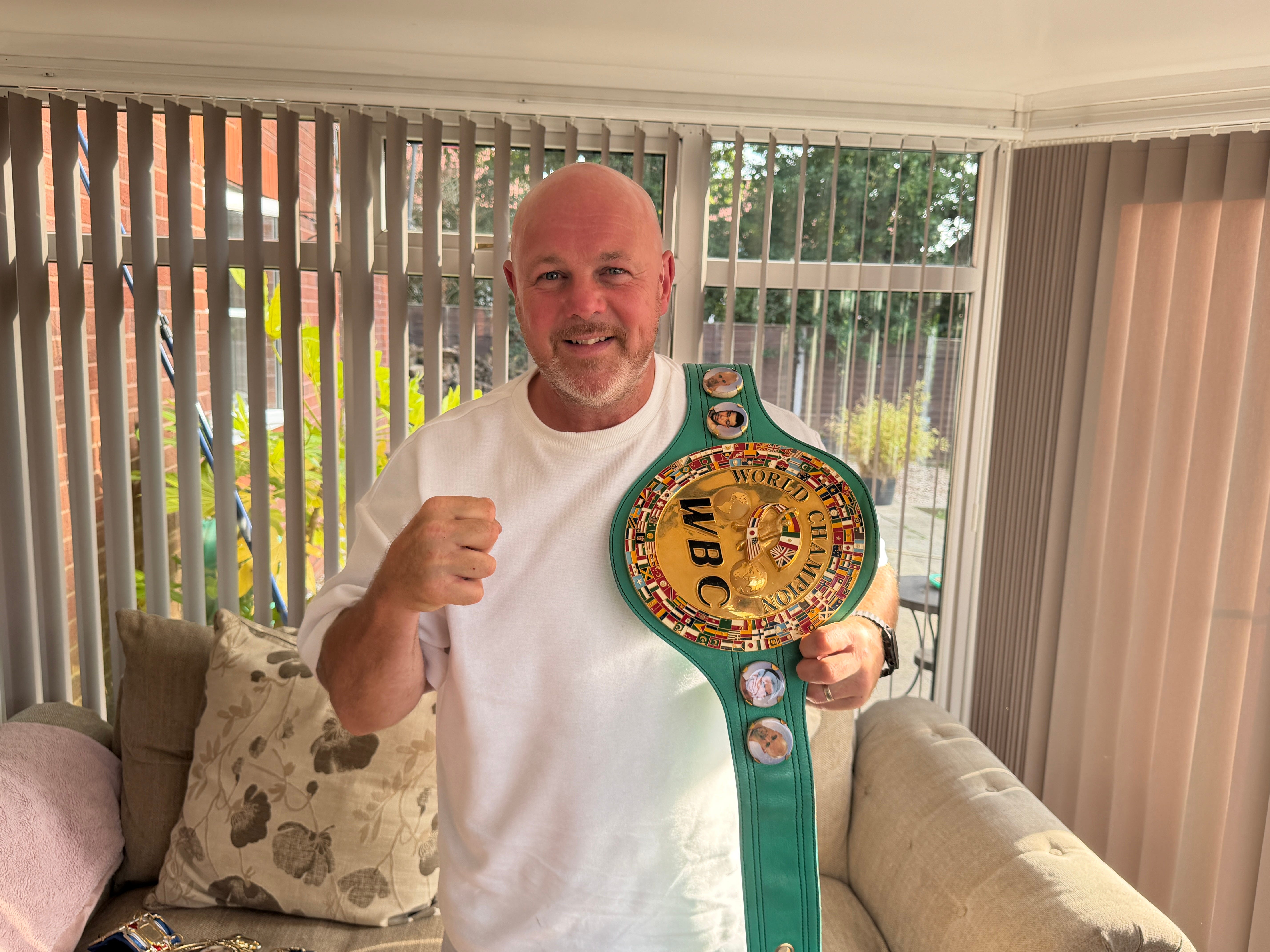
Glenn Catley sits back on his sofa.
He then leans forward, making some adjustments to the blinds so the sun doesn’t shine in his eyes, and eventually settles where feels natural and comfortable.
“There’s dog hair everywhere,” he smiles, switching his phone onto silent so we can talk.
He’s familiar with his surroundings because we are in his home. But the former WBC super-middleweight champion will not be calling it that for much longer.
Catley’s lived here for 26 years, on the fringes of Bristol, and he’s seen his family grow up and his two daughters and two sons move out.
That is a reason behind the downsize. But there is another cause for moving, too. The money just isn’t there any longer for the man who fought the likes of Richie Woodhall, Dingaan Thobela, Eric Lucas, Markus Beyer and Danilo Haussler.
Catley is a 54-year-old delivery driver who happens to have a green and gold belt in his home.
Those titles, handed out to those who win the coveted WBC straps, are the things dreams are made of and what fighters go through unthinkable pain and sacrifice for.
Catley went through the pain. He made the sacrifices. And he’s left with the belt.
“Do you know what,” Glenn sighs as he looks at the championship on his lap. “You’re going to find this quite – perhaps – offensive. It doesn’t really mean a great deal to me and that is quite sad really, but, yeah. My ultimate goal was to win titles, but also ultimately it was to make myself financially stable and sadly that just never happened.
“We’re selling this house. We’ve raised our kids in this house. They’ve had a great upbringing. We’ve been here for 26 years, but we’re selling because we’re just going to try and make life a bit easier for ourselves. We’re downsizing. It’s a new house, so it’s about me and Kelli now. The kids have grown up and moved on. It’s our time now and it’s just about trying to make life easy.”
The couple has been married 27 years and Catley has a kind manner.
He is generous with his time and his stories, but finds it difficult to get beyond the lamenting thoughts that things should have been different.
“It’s, well, sadly and very unfortunate, I never made much money out of boxing, you know, so I never… my intention when I started boxing was to win the titles but ultimately to make myself financially stable. Unfortunately, for reasons I won’t bore you with, that never happened. I had to go back to work and I’ve done all sorts in the last sort of… you know, my last fight was 2007, so we’re coming up for 20 years ago now.”
Catley came back for two fights in 2006-2007, won both and walked away. He was at his best when, in 1999, he travelled to Canada to upset Eric Lucas in an eliminator for the WBC title and, in his next fight, when he won the belt in Germany against Markus Beyer.
They were brilliant back-to-back away victories and a far cry from the life Catley has gone on to live.
“I’ve done lorry driving, I’ve done scaffolding, I’ve done security work, I’ve done shuttering and steel fixing, I’ve done all sorts,” he tells me. “I’ve done sales and I’m currently now a delivery driver at the moment. It’s not ideal but, you know, I’ve had to go back to work because sadly, like I say, not like the bigger names, like your Joe Calzaghes and your Carl Frochs, I never made any money really out of boxing, and I had to go back to work. It’s a small percentage though [who make enough to not work after boxing] and the thing is as well, the ones that do, they don’t always keep it anyway. I think one per cent of the boxing fraternity make enough money to retire on and, sadly, I wasn’t one of those.”
Glenn wears a baggy white T-shirt, pale blue shorts and his goatee is more grey than brown. He’s thicker-set than he was in his 168lbs pomp but has a hefty handshake and surely plenty of West Country strength in him.
Physically, he’s fit. He’s a strong conversationalist, but something’s amiss.
He has been diagnosed with early-onset dementia.
“I’ve been under examination for the best part of probably two years now,” he reveals.
He has been told he has chronic traumatic encephalopathy (CTE), a haunting diagnosis that often indicates things do not get better.
It was once known as punch-drunk syndrome, and then became dementia pugilistica. In the modern lexicon, it is CTE.
“I didn’t know what it was, not until being diagnosed,” Catley explains.
“When they told me, when I was out under observation, they told me the possibilities of having CTE and I did a bit of research on it.
“My memory was bad. My wife, she’d send me to the shop to get three things and I get to the shop 10 minutes later and I just can’t recall what she’s asked for, so I’ve had to phone her up – and this happened numerous times. Sometimes, I’ll be driving and I just go to a completely different location and some people say, ‘Glenn, I do that all the time.’ But when it happens regularly, you start thinking about it. I get confused. I do get confused in a conversation with a group of people and if we’re in a group of people, I get confused quite easily now.”
Catley is an inspirational figure. For years, he has been a busy and invigorating motivational speaker, but mood swings are, too, a symptom of too many blows to the head.
“Maybe that’s why I’ve started thinking about it. The negativity a little bit,” he admits.
“I was on sertaline for a little while. You’ve heard of sertaline? It’s like an antidepressant, if you like. A lot of, a lot of people are on sertaline. It’s quite a common thing apparently, but it has helped. It’s sort of lifted my mood up because not so long back, when we decided we had to sell this house, I was upset. I lost the job I was in. Life was pretty tough and then I was in a bit of a bad place. I found myself just crying every sort of half an hour. And I’d just cry on my own. I wouldn’t want to literally cry in front of people, but I’d always just end up finding myself crying. There was no reason for it.”
And while he shares what he’s going through with Kelli, the inevitability of what is to come is forever sobering.
“Kelli’s been going to all the appointments with me, to be honest. And I’m under Dr [Kanch] Sharma, who’s the brain specialist, if you like, for the British Board of Control. He’s been very helpful, very, very good and he explains everything to me very well, because I need a lot of explaining these days. But, yeah, CTE is… they can’t cure it, but they can slow things down. And obviously I want to get on medication as quick as possible because I don’t want to get worse.”
Glenn Catley turned pro in 1993. He defeated the 5-14-2 Rick North, from the fishing town of Grimsby, at the Whitchurch Sports Centre in Bristol. Glenn won 40-38 as part of a five-bout bill. That was in May, and by the end of the year he was 6-0 with three stoppage wins.
He opened his account in 1994 with his seventh victory, but lost fight number eight when he realised, albeit at late notice, that he wasn’t a light-middleweight any longer.
He toiled to come in at 154lbs to face Welsh veteran Carlo Colarusso, and Glenn was stopped in the fifth.
Asked whether he recalled his bell being rung in sparring or in many fights, Catley replied: “It happened too many times to be honest, for me to pick out any individual.”
“What about going into fights, like when you’d been hurt, dropped or concussed in sparring, did that happen?”
That prompts him to recall the Colarusso fight when “he was turning into a man” and outgrowing the weight.
He had been finding weight-making challenging and then took a call on a Sunday night asking whether he could make the weight for the Wednesday fight.
The gym scales the next day told him he had 12lbs to lose.
“And for the next two days, I put myself in the sauna, boiled myself right down, and I made the weight as if it was for the world title,” he recalls.
“I was completely and utterly drained, because I remember before the fight, my head is just thumping, I had a banging headache because I was just so dehydrated. And you cannot sensibly rehydrate yourself in that sort of small period of time, you know, six hours [in the era of same-day weigh-ins].
“Anyway, I remember driving home that night with my old amateur trainer, Alan Thompson. He actually drove me home that night from Wales.
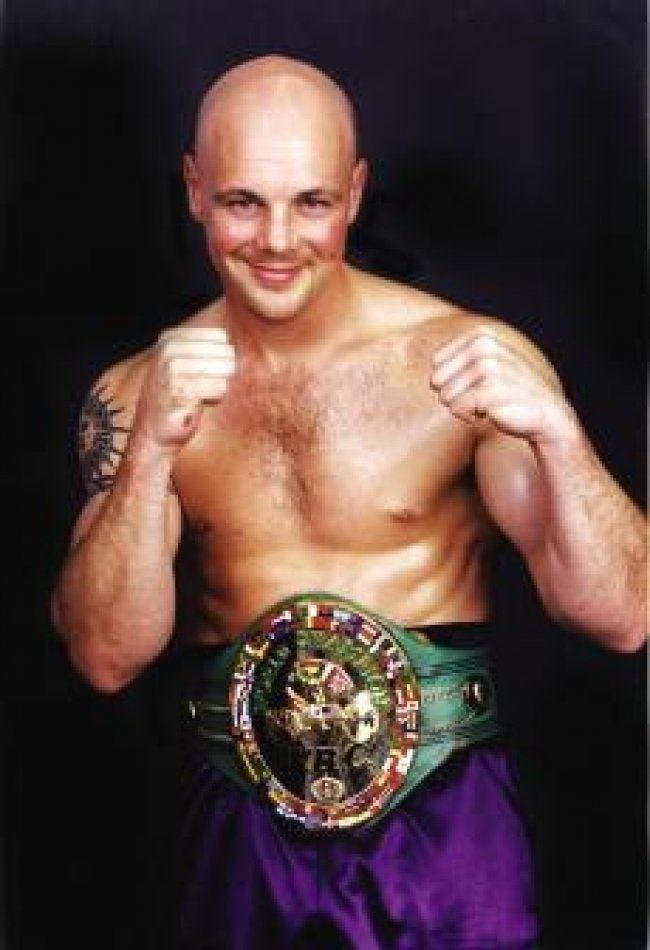
“I was 21, 22, maybe 23 and when I was offered the fight, I felt like I had to take it because I didn’t want to let people down. I took it and that was my first defeat. It was a bit of a learning curve, a hard learning curve, nevertheless.”
Catley weighed almost 10lbs more for his next fight two months on and never boxed at 154lbs again.
**
“Looking back, obviously for me, I was happy that it was a chance I was willing to take to not be one of those people that sadly got it,” Catley said of his knowledge of fighters winding up damaged by the sport. “Unfortunately, that wasn’t the case. I have got it. And yeah, it’s quite shocking when you read some of the reports. Some of them have said you could be dead within six years because of it but I like to think I could still have a conversation and am still sort of compos mentis, as they say. I know that maybe 10 years, maybe 20… I don’t know how long. Concussion, it’s no surprise really, because concussion, and although I didn’t tell a lot of people about it, but concussion was a regular occurrence for 30 years. I boxed for the best part of 30 years as an amateur and as a pro, and it was a regular occurrence. I can remember driving up the M32 many a time after a training session, after a sparring session, and thinking, ‘I should not be doing this. The road’s just a blur.’ But it’s something you just become accustomed to, I guess.”
Nowadays, when he’s out on the roads making his deliveries, he’s occasionally stopped.
“‘You’re Glenn Catley?’” they ask.
“‘The world champion boxer.’”
“They are amazed to see what I was doing but when I told them I really didn’t make any money out of boxing they were quite shocked because everybody thinks – and they would naturally think because I’m a WBC world champion – I’m a millionaire but sadly, that wasn’t the case. I never made any decent money out of boxing.”
Catley reckoned his career-highest purse was £130,000 for the night he lost his title, in South Africa, to Dingaan Thobela. The Bristol man was stopped in the 12th round and said his preparation for fight in Johannesburg was all wrong and that he’d left it far too late to acclimatise. He wilted with seven seconds left in the fight.
Then, Catley explains to me the way a fight purse is broken down, including 25 per cent to his manager before commissions are paid, sanctioning fees and paying his own tax.
“So, it soon boils down, so maybe I would have taken between, I don’t know, 60 and 70.
“It’s a great purse but when you’re only fighting once a year, once every sort of 14 months, it doesn’t really last long because when you’re dipping into that lump, nothing’s coming back in, it doesn’t last a great deal of time.”
But there were highs, not least winning the world title.
After twice boxing Joe Calzaghe in the amateurs – “I knew he was special” – there was a spell training with the brilliantly tough Irishman Steve Collins in Jersey, when Collins was working under Freddie Roach.
“Steve was incredibly tough. He had one gear, fifth. That was it,” Catley grins.
“He just did not take a step back. He just came forward, forward, forward. I learned so much working with Steve. I learned so much with Freddie Roach as well. It was three camps we did, 10 weeks at a time, I believe, and to this day, I suppose, it was the best 18 months of my entire career, professional and amateur.”
It was during that period that he and Kelli met on the island.
Glenn borrowed someone’s Mini Metro to take Kelli out and they went to a restaurant.
Three decades on and they have four children, Lacey, Baylee, Riley and Ellis.
Riley started to box but after 12 amateur fights and his father’s diagnosis, he stopped.
Glenn admits he often feels bitter, angry, frustrated and “disillusioned by the game.”
Does that mean he would dissuade young boxers from lacing up the gloves?
He hesitates to think about how best to answer.
“That’s a real difficult question,” he says.
“Boxing does so much good. It’s made me the person that I am. It’s a really tough question, you know, but I think it’s just making everyone aware. Nobody ever said to me, sat me down and said, ‘Right Glenn, if you box for 10 or 20 years, this could be the outcome.’
“I was never, ever told that. I was never given the explanation. I was never given the education.”
Catley thinks more needs to be done to inform coaches about the risks, in the amateurs and the pros. He talked about the Board of Control monitoring a focus group of fighters to learn about the dangers and to study the effects so boxers are aware that “this is the possibility of what you could end up with if you continue to get punched in the head.”
“Just give some realism to the boxers.”
Would he have listened if someone had told a young Glenn Catley what to do?
“If someone had sat down and showed me the brain scans of one boxer to another one and actually showed me, it might have ignited something in there, where you’ve got it in the back of your mind.”
