


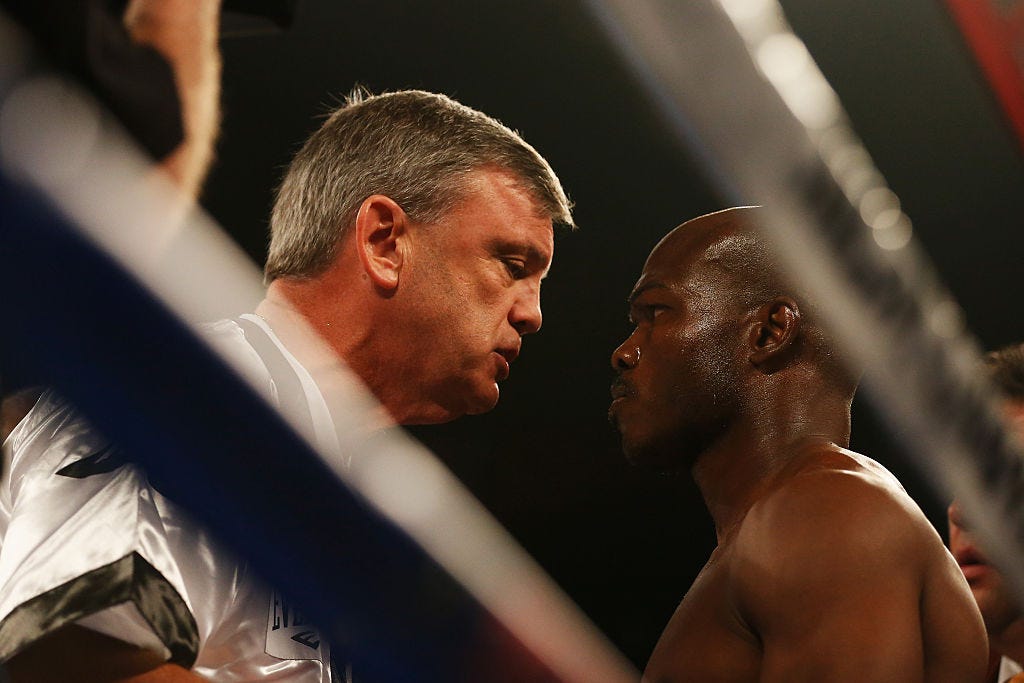
In the first of two parts, Teddy Atlas talks about the “suffocating” fear of failing a fighter, putting the pads on for his grandkids, Catskill, and why he said ‘No’ to appearing in the new Netflix series TYSON.
All his life, Teddy Atlas has tried to understand people and that could be considered both a marvellous strength and a terrible weakness.
He has taken vulnerable fighters and made them bulletproof, turning them into champions, although some turned against him.
Atlas has made decisions that have cost him millions, and others that have cost him friendships.
Now 70, the former trainer and television analyst has few regrets, but plenty of scars.
He is also as busy as ever.
Atlas has his own podcast and YouTube channel, and Dmitriy Salita has reached out to bring him back as an analyst for his shows on DAZN.
And through it all, Teddy has remained unfiltered.
Even 40 years ago, in Gleason’s Gym, that was the case.
“But it’s not what it used to be at all,” laments Atlas about the boxing landscape.
“It’s not, even 20 years ago. But I’ve known this [for] 45 years, where anyone could walk in the gym, throw a towel on their shoulders. There’s no screening. There’s no accountability.
“There’s no validation. There’s no checking their background of, ‘Oh, what did they do?’ They just get around the fighter. They come and next thing you know, they’re a trainer.”
Teddy has seen it on loop over the years and nothing surprises him any longer.
“If I told you some of the stories, you wouldn’t believe it. You wouldn’t know whether to laugh or cry,” he says.
“I saw people come through the doors at Gleason’s Gym, when we were in Manhattan, out of nowhere, and start training fighters. And they got away with it.
“I remember the Daily News did a big story with me because I said half the people in this business should be arrested for impersonating trainers.
“If they tried that in the medical business, patients would be dying everywhere. They wouldn’t be allowed on a football field to coach because they have no background. The players would be running in the wrong direction.
“But in this freaking business, they can all come in with no screening, no background. It’s absurd. No apprenticeship, nothing.”
Of course, not everyone gets to cut their teeth under one of the great coaches and mentors, having to train fighters with every move being scrutinised, assessed and judged, rightly or wrongly. But that grounding gave Atlas a rare wisdom and it meant there was nothing fraudulent about him when it came to coaching fighters.
Even in the 1980s, Atlas said all of the above to a reporter in the New York Daily News.
“I walked into the gym the next day and three old-time trainers were there.
“Freddie Brown, who trained Roberto Duran, he loved me. Ray Arcel had come by, and Lee Black. They were real boxing trainers who had seen the deterioration of their sport, of the teaching of their sport.
“They all had the Daily News and they came over to shake my hand.
“They said, ‘Thank you for saying what needed to be said.’
“I was still a kid. I said, ‘Well, there’s a few people in here who ain’t too happy.’
“They said, ‘We don’t give a crap about them. We’re happy. Of course they’re not happy.’”
*
Atlas had a second career as a long-time TV analyst but, even then, his expertise was sought by fighters who wanted his knowledge, his wisdom and, likely, his delivery.
He could motivate and he could counsel. He could preach and he could listen. He would fight for you and fight with you, but you always knew he was on your side.
Now he travels an hour each way once a week to hold the pads for his grandchildren.
“I don’t miss it. I joke with my grandsons that the good thing about training them is they don’t argue back,” he smiles. “But none of my fighters really argued back.
“The purity of it is still there. I’m a teacher. There are very few teachers out there. Watching a guy learn, teaching him to get better and being part of that, that’s special.
“But going to camp, being isolated, being away from your family... that part I don’t miss.
“And what I dreaded, especially in the later years when I came back sporadically, was the responsibility.
“Every time I came back… after four years out [or however long], I’d come back with a guy fighting for a world title and win it.
“Come back with Povetkin, win the world title. Come back with Gvozdyk, win the world title. Come back with Timmy Bradley after he almost got knocked out in a fight, and win a fight against a guy who had never been stopped.
“I was blessed to be asked to come back and do that.
“But the part that got really hard for me, the part I don’t miss – and most people don’t understand this – was that every day, when I got up in the morning and went to bed at night, I’d ask myself, ‘Did I do everything right?’”
He also understood there were elements beyond his control. Teddy knew he had little influence over the other side, over judges, over anything else other than what he had control of.
To that extent, it gave him sleepless nights.
“Am I gonna fail him? Because every one of my fighters believes in me, maybe more than they believe anyone else. I can’t train them if they don’t.
“And I don’t train someone if they don’t have character. If I don’t think they’re a decent person, I’m not training them.
“The other reason I say yes is because they need to get better in a certain area and I feel I can make them better. Maybe someone else can’t, but I can.
“But throughout the camp, I would always be thinking, ‘Am I gonna fail them? Am I gonna let them down? Am I gonna betray that confidence?’
“They trusted me, and I couldn’t guarantee everything was going to be okay.
“Just the weight of that got suffocating after a while.”
**
That infamous Catskill apprenticeship was the making of Atlas. It was a detailed seven-year psychological crash course that culminated with a well-documented altercation with Mike Tyson, a handgun and Atlas being jettisoned from the camp by guru Cus D’Amato.
A lot of wounds remained unhealed from that period of time, but Atlas still holds stock in plenty of what D’Amato taught him.
Asked whether much of what Cus had told him came true, without hesitation, Atlas answers, “Yeah.”
And with very little pause, Atlas adds: “He told me people born round don’t die square. So true. So true.”
**
It is arguably the failure to lure Atlas onto the screen that is the major gripe with the new Netflix series, TYSON. Many feel that Catskill flashpoint set the tone for Tyson, enabling bad behaviour that followed, rather than trying to fix, address or punish it.
