


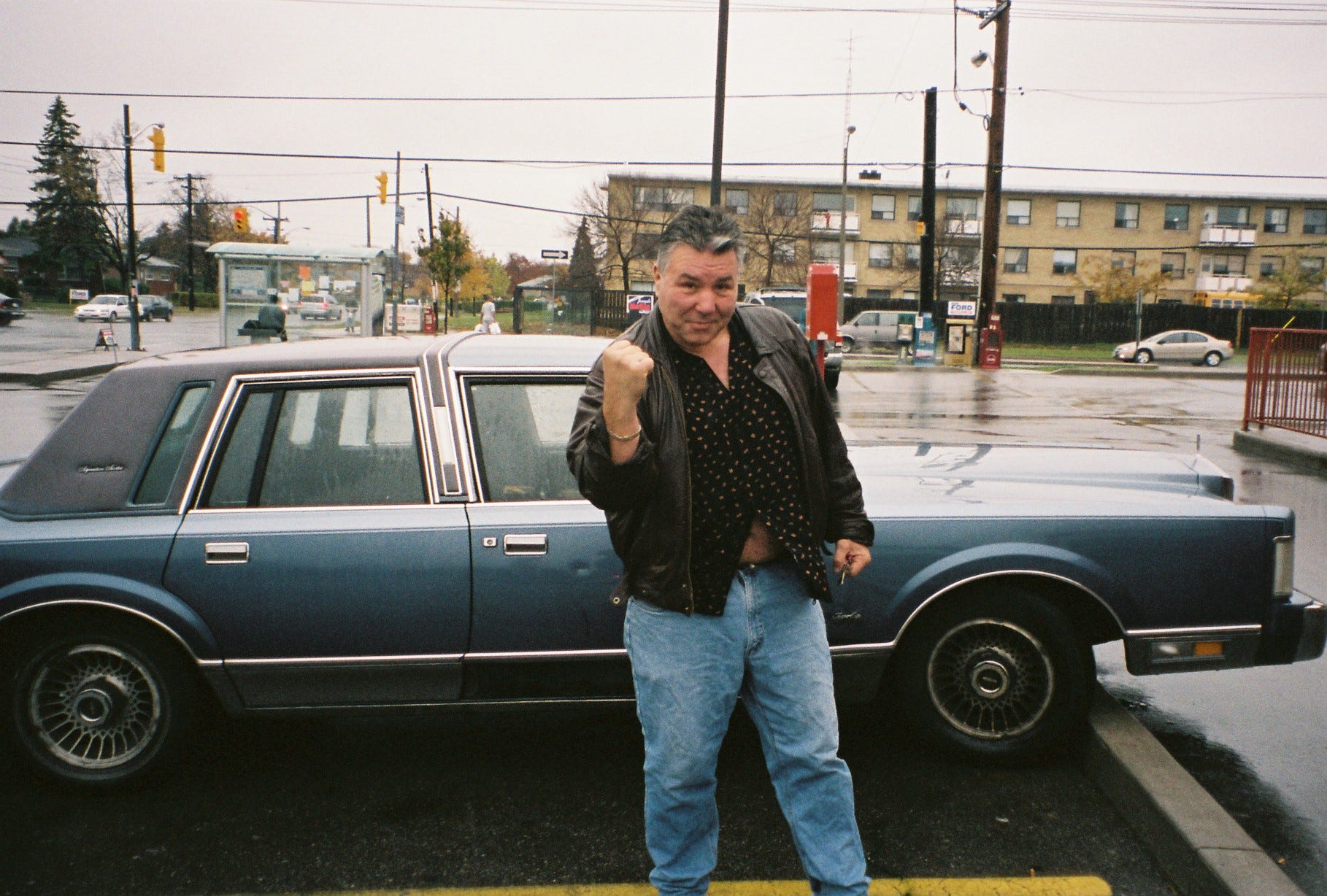
I was so engaged listening to his story that nothing else mattered.
George Chuvalo had arrived a little late to meet me in a coffee shop in rainy Toronto, but I was grateful he’d made it at all.
I’d been blown off by Rubin “Hurricane” Carter and Chuvalo proved a failsafe, but I wasn’t ready for what was to come.
Sure, I knew about his family tragedy and that he’d fought Ali, Frazier, Foreman and the best of his generation.
I knew he was arguably Canada’s greatest heavyweight.
And I knew about the rock-solid chin and that he was often heralded as one of the fighters not to exhibit signs of his brutal profession long after he retired. Given he was known for his durability, that was quite the compliment and he must have had neurologists scratching their heads.
How did a man who’d taken so many bombs from so many huge punchers remain so lucid? Where was the short-term memory loss, the slurred speech, or the unsteady walk?
Well, when George came bowling in to meet me, I was thrilled.
George Chuvalo won 73 times as a pro, losing 18 fights and drawing twice. Famously, he was known for never being dropped, though he didn’t hear the final bell against Frazier or Foreman. No matter. He was a walking lump of granite and he could really fight. Chuvalo was 4-0 after his first night as a pro after he chinned his first four opponents in Toronto’s Maple Leaf Gardens in a tournament named after Jack Dempsey. There were a couple of early losses as he cut his teeth, but in 1959 he won the Canadian title with a 12th-round stoppage of Yvon Durelle.
He won and lost in equal measure through the early sixties, picked up a DQ for headbutting small Welsh heavyweight Joe Erskine (claiming he was retaliating for being thumbed in the eye) and lost to the decent Zora Folley. But he stopped contender Doug Jones, Syracuse heavy Mike DeJohn, and lost a blistering 1965 battle with Floyd Patterson in the Fight of the Year. I remember George telling me that Patterson, “had a left hook that could tear your brains out.”
George had to gulp down a good few of them.
George, who told me “Two Ton” Tony Galento taught him how to headbutt, felt he was robbed losing a decision to Ernie Terrell over 15 rounds and always believed the Chicago man’s manager, Bernie Glickman – who had colourful ties to the underworld – made sure the fix was in.
He actually went into a heavyweight title fight against Ali coming off a loss to Eduardo Corletti in London, and that came after a victory over Joe Bygraves in London’s Royal Albert Hall. My friend George Zeleny was at both fights, and said of Chuvalo: “Hard, hard man.”
That could be on his headstone.
Chuvalo lost a decision to Ali over 15 rounds having accepted the fight with less than weeks’ notice and lost a decision to Oscar Bonavena.
As I interviewed him, I recall Chuvalo snapping at me – given the big names he fought – “I see what you’re doing, you’re only asking me about the fights that I lost.”
As I meekly apologised, he interrupted to tell me he was joking.
He won 11 on the spin through ’66 and ’67 but then ran into Frazier in Madison Square Garden and Chuvalo was cut badly early. The would by his eye went down to the bone, which was broken. He needed surgery, but he fought on.
Reporter Mark Kram said Chuvalo had “a rocklike head” and that was meant as a compliment.
He took some monstrous blows against the Philadelphia left-hooker, his face turned purple, wrote one ringside scribe, and a blood vessel leading to his eyelid exploded.
“I thought my eyeball had been knocked out,” he later said.
Chuvalo had damaged it in an earlier fight and then again in sparring, so said he was “damaged goods” for that contest even before the first bell.
He was out for nearly a year and former heavyweight champion Joe Louis refereed his next fight, a stoppage of Canadian left-hander Jean-Claude Roy.
Chuvalo lost only one of his next 13 and scored arguably his best win, claiming the scalp of Jerry Quarry, back in the Garden, in 1969.
During that bout, Chuvalo’s eye again started to balloon but a left hook dropped Quarry and he was unable to beat the count. At least, he didn’t beat the count. Quarry later claimed he had not heard the referee over the din of the crowd.
“If you get hit with a good punch and you can’t tell nine from 10, what can you tell the guy?” joked Chuvalo, who made a respectable $15,000.
But a few fights later he was up to $50,000 when badly whipped by a marauding Foreman. As Chuvalo tended to his wounds afterwards, he was offered an ice pack.
“What’s that for?” he asked dryly.
In 1971 he lost to Jimmy Ellis but beat Cleveland Williams. In 1972 he lost a rematch to Ali over 12 but won two other bouts later that year, won two fights in 1973, two in 1977, one in 1978 and that was that.
“The Toronto Tank” – a name that never stuck – had fought 502 rounds as a pro.
He had more than played his part.
“When people think about the best heavyweights they think of my era,” he said. “It was the best era. There’s no question.”
**
Three of George Chuvalo’s sons left this world too soon, two by suicide and one by overdose. His wife, Lynne, kept a container of pills in the wardrobe for when all hope was lost and, after 36 years of marriage, she ventured upstairs, opened the wardrobe, opened the container and ended her own story of heartbreak.
George’s family had been decimated, but as he had done in the ring, he stood firm.
To this day, I remember asking him about suicide and he said, “Who in a normal life doesn’t consider it?” And it was the first time I learned that it was okay to talk about not being okay and learned the difference first-hand between suicidal ideation and suicide.
Drugs had ransacked Chuvalo’s family and he made it his mission to help others who were at risk. He started a charitable foundation, Fighters Against Drugs, and went to schools, prisons, and other community centres to tell his tragic story. Often, he’d receive a standing ovation.
He spoke with passion and from experience.
“It’s true, what can I say?” he replied, when I told him he’d led a tragic life.
“I’ve had more than my fair share. More than the average guy. I don’t know how to explain it. I guess I have whatever is in a person’s make-up that enables them to go through it. I don’t know. I only know how I would deal with it. I couldn’t tell you how anyone else would because I’m not you and I’m not them.”
Chuvalo was left with one son, Mitchell, and his grandchildren, and he said his world revolved around them.
In the coffee shop, George showed me photographs of his dead children, but he never cried. Like he was never dropped in the ring, he never shed a tear when we talked.
***
When lists of great features fighters possess are reeled out, Chuvalo is often the gold standard when it comes to ‘chin’.
Mike Tyson might have power. Ali might have charisma. Holmes might have the jab, but chin goes to George.
I asked him about his durability.
“If you have a neck like a stack of dimes you can know that guy’s getting knocked out,” George said. “I used to stand on my head a lot. A lot of people don’t understand. Fighters pay scant attention to the punch-absorbing muscles…. Very few fighters spend time on muscles to absorb punishment. I used to spend a lot of time on it. It’s important.”
But while Chuvalo knew he’d seemingly come through the battles unscathed, others were not so lucky. By the time we talked, many of his contemporaries had passed or were showing signs associated with chronic traumatic encephalopathy.
“One man’s meat is another man’s poison,” he stated.
“Before I started fighting, I used to stutter and couldn’t remember a God damn thing. Now I remember everything and don’t stutter at all. I’m lucky that way, but to be honest with you, there’s a very popular misconception. The misconception is I got hit with every punch in the book. I didn’t get hit with one-tenth of the punches people thought I did… But you never know how you are going to be tomorrow. Like today I’m all right. Who knows how I’ll be tomorrow?”
****
Fortunately, it would take many years to reveal itself, but by 2019, the ugly decline brought about by too many punches to the head had taken a firm hold.
There were sad stories about George being so diminished that he was in a custody tug of war between Mitch and his second wife, Joanne.
In fact, a year earlier, in a Chuvalo vs. Chuvalo family case, the court heard that Chuvalo, then 80, “doesn’t have the cognitive ability to make a decision on whether to reconcile with his wife amid a family dispute.”
Even then, eight years ago, the Toronto Star told of Chuvalo’s “significant cognitive decline.”
It was sad to hear. While I’d met Chuvalo amid the autumnal showers in Canada, he was bright and breezy when we spoke, but he had to endure a long, cruel winter of his life.
*****
That will not be Chuvalo’s legacy, nor should it be. George’s story of survival and courage – particularly out of the ring – was inspiring, motivational and stirring. He had withstood a terrible burden but he’d carried it on his broad shoulders.
I asked George – more than 20 years ago – how he’d like to be remembered and he answered: “I just hope they remember me,” he smiled gently. “I kind of like, ‘He was a warrior.’ Exclamation mark. If my great, great, great, great-grandchildren say, ‘He was a warrior!’ then that’s good enough for me.”